Course walkthrough
The full course is live: launch it here.
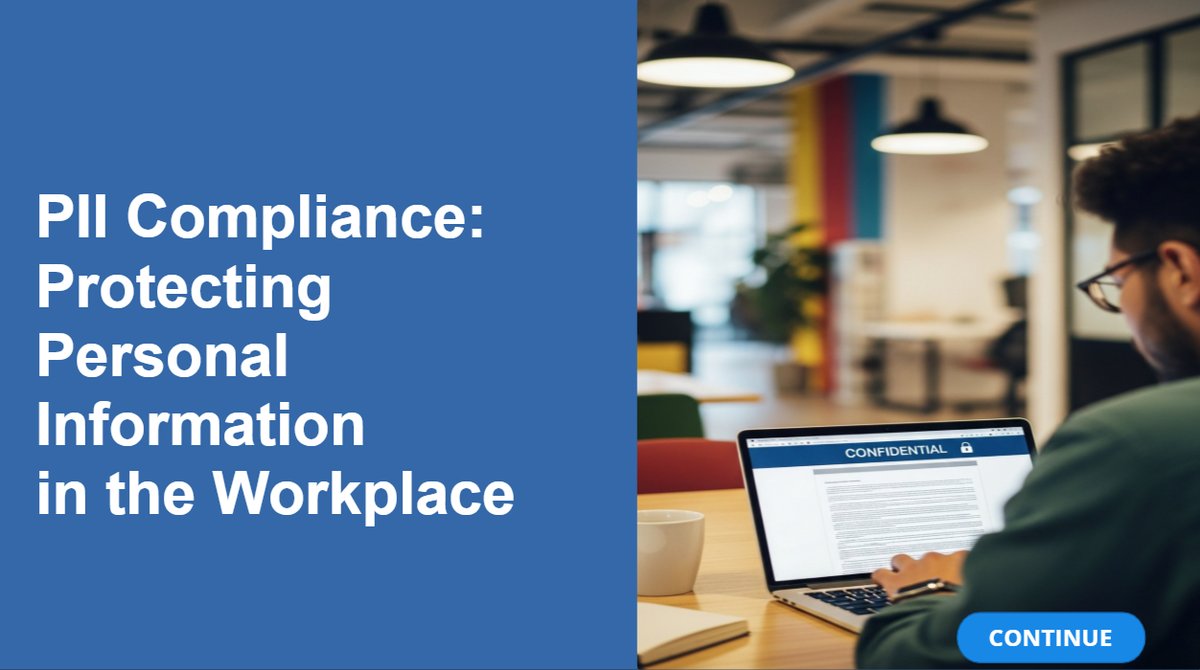
A scenario-based eLearning course designed to help employees make sound decisions when handling personally identifiable information.
Compliance training often presents policies as lists of rules. That approach may help learners recognize terminology, but it does not necessarily prepare them to make good decisions under pressure. This course focuses on application rather than memorization, built around realistic privacy and information-handling risks commonly found in business environments.
The central question: how can learners practice identifying privacy risks before those risks become workplace incidents?
Employees in regulated or information-sensitive work environments who handle personal, customer, or employee information.
By the end of the course, learners should be able to:
I used scenario-based learning because privacy violations often result from routine decisions rather than a lack of policy awareness. The course includes three workplace situations involving identity verification, secure transmission of information, and appropriate storage and handling of confidential records. Learners make decisions and receive immediate feedback explaining why a response is effective or risky.
The scenarios center on how privacy actually breaks down in practice: responding too quickly to a request, choosing convenience over secure procedure, sending information without fully verifying the recipient, and storing or transporting documents improperly. This let the course address behavior and judgment rather than simply restating policy.
Each decision produces feedback explaining why a response is effective or risky, correcting misconceptions at the moment they surface.
The knowledge checks were designed to reinforce decision-making and practical application, testing each objective from a different angle than the scenarios.
The course incorporates clear navigation, consistent layouts, readable text, logical interaction patterns, and feedback that does not rely only on color.
The full course is live: launch it here.
This course was built for my portfolio and has not been deployed to a live workforce, so no performance data is claimed. It demonstrates my ability to translate a compliance topic into scenario-based learning, build a complete Storyline course, and create decision-focused interactions rather than passive policy review.
This project strengthened my ability to connect compliance content to realistic workplace behavior. If I developed the course for an actual organization, I would work with legal, compliance, and operational stakeholders to validate the scenarios, terminology, policies, and escalation procedures, and I would evaluate learner performance and workplace error patterns after launch.